§ 1
Overview
Spoken language models (SLMs) enable natural human-computer interaction, but their reasoning ability still lags behind text-based LLMs, especially on spoken mathematical question answering. A key reason is that SLMs reason over purely verbalized mathematical expressions, which are harder to interpret than symbolic text.
We propose Efficient Chain-of-Modality Reasoning (ECoM Reasoning) — the first framework to introduce compressed reasoning into SLMs. By compressing the textual component so it jointly serves as speech guidance and reasoning representation, ECoM Reasoning improves accuracy while using a dramatically smaller token budget than standard CoM.
Training employs Progressive Compression, a curriculum-based strategy that gradually transitions the model from full-form reasoning to compressed reasoning traces.
no reasoning
full traces
budget used
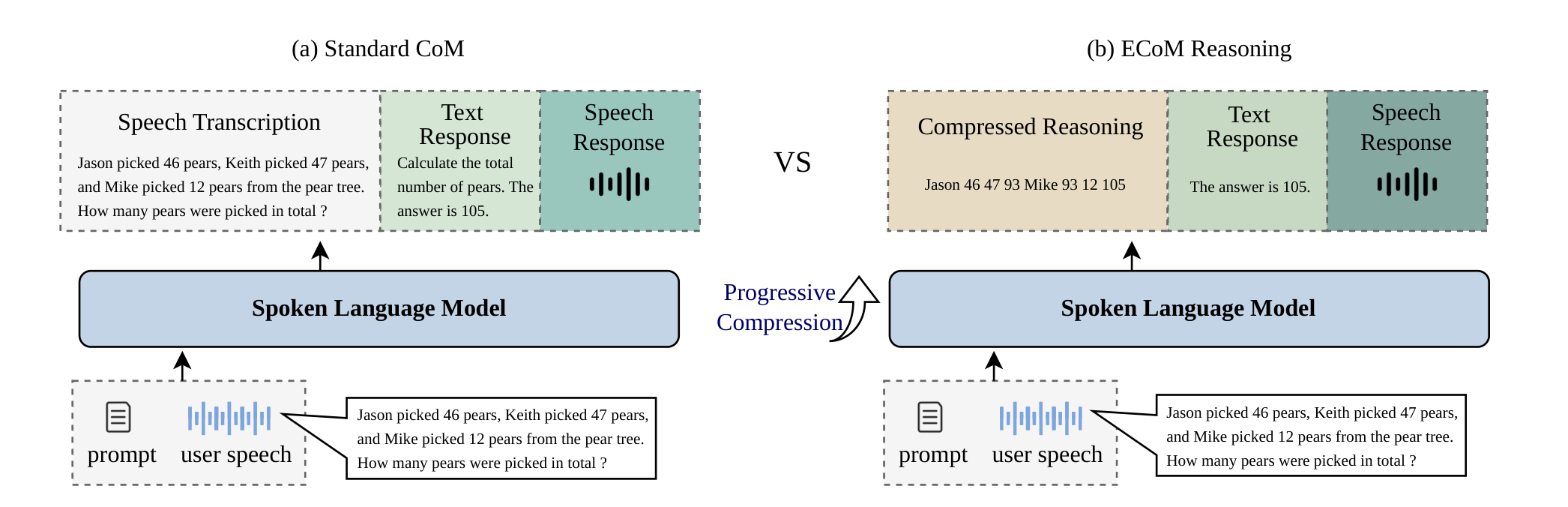
Figure 1. The ECoM Reasoning Framework. The text reasoning component is progressively compressed during training, ultimately serving dual roles as both speech guidance and compact reasoning representation.
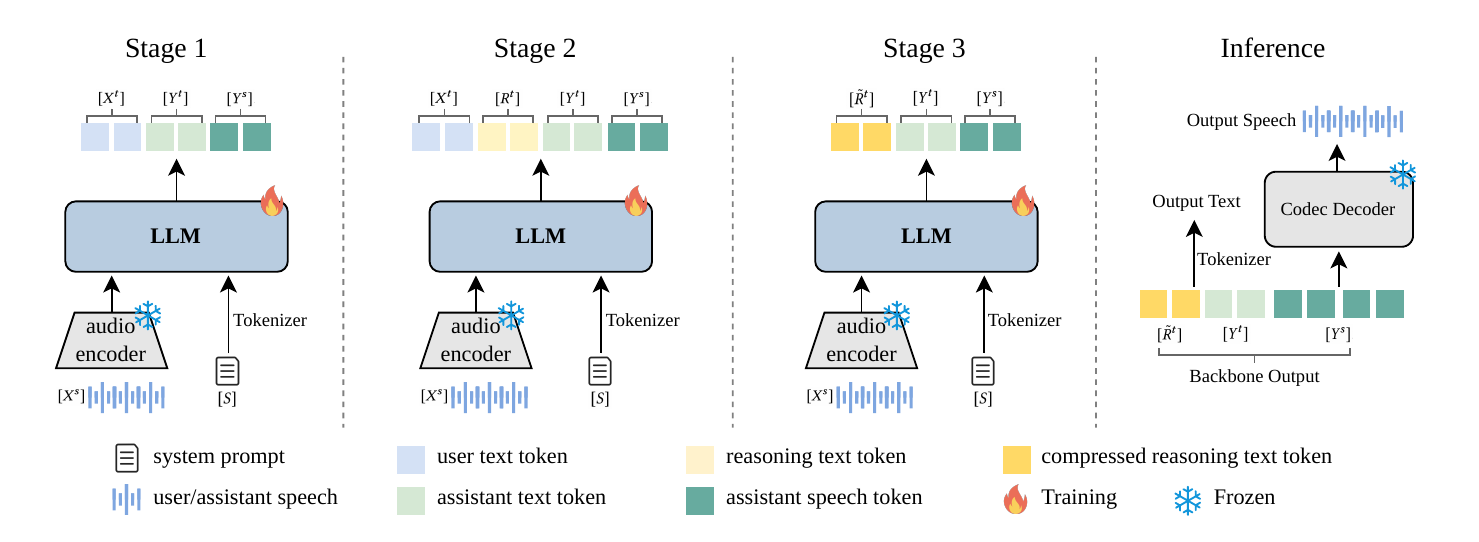
Figure 2. The Progressive Compression training pipeline. Stage 1 trains on direct answers; Stage 2 introduces full reasoning text tokens R′; Stage 3 replaces them with compressed reasoning tokens R̂′, which are then used at inference to guide speech generation.
§ 2
Token-Level Compression Examples
Progressive Compression reduces the reasoning trace token-by-token. Each row shows the retained text at a given compression ratio. Highlighted spans are answer-critical tokens preserved across all levels.
a) What was the weather on the 10th day? How many problems? b) What is the maximum Vasya could solve on the 15th day?
§ 3
Framework Response Comparison
Three frameworks on four question types. Audio outputs are generated speech from each model. CoM Reasoning uses the full chain-of-thought trace; ECoM Reasoning uses a compressed trace at ~40% tokens.
§ 4
Compression Ratio Ablation
Sweeping the compression ratio from 100% (full trace) to 0% (no trace) on ECoM Reasoning. The 40% ratio achieves the best efficiency–accuracy trade-off and is marked as the recommended operating point.